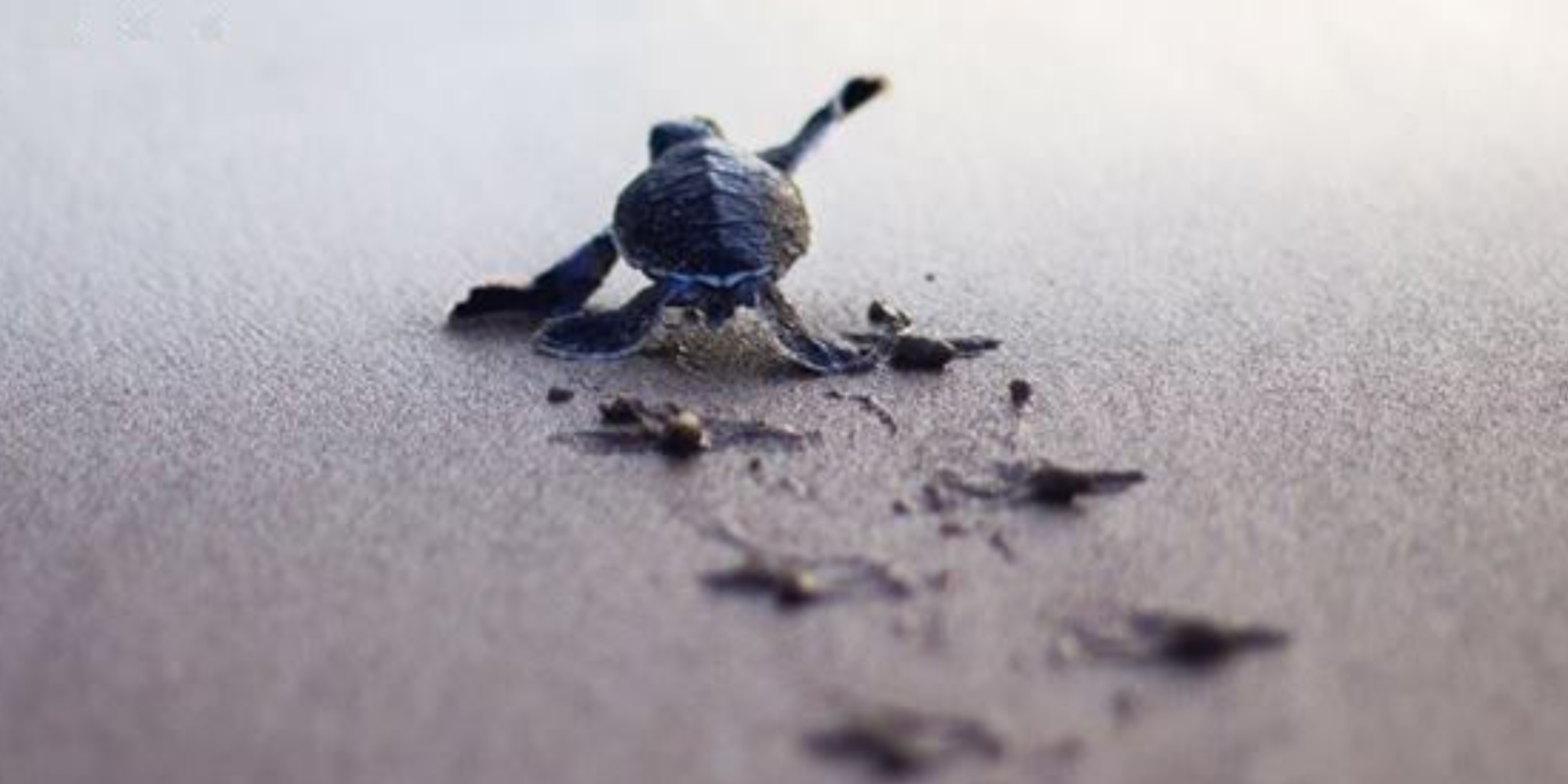
Though the sand hole was not too far away, the early morning sunlight just beyond cast a golden shimmer that turned every small stone and beachy creature into a silhouette, and I was not sure what it was exactly that caught my eye. Its movement was strange.
I could tell the shadow was not that of your typical beach find. Driftwood, seashells, broken rocks, and such.
This shadow fumbled and frisked along the sand, then submerged quickly. Like a hand fingering the air clumsily before disappearing into a too-long sleeve.
Was that a crab? There were too many legs, even if the frantic shadow belonged to a crustacean. From my distance and the distortion from the sun’s glare, the dimensions seemed all wrong.
A sapphire tide was rising, foamy bubbles easing their way up the sandbank, caressing pebbles, and filling sand holes at its leisure.
Calming, but still. A drama was unfolding.
It’s high-season for nesting sea turtles in Nicaragua, and even though we have a sea turtle hatchery on our beach, the stretch of sand is too great a length to patrol with any regularity, and sea turtles hatching in the wild is still a common sight.
The waking moments of a baby sea turtle are nothing less than remarkable. They hatch only to find themselves buried alive two feet underground, smushed amongst their siblings’ limbs and broken shells.
It’s an alarming way to discover you’ve been born.
Their next movement is to dig themselves up and out. Elbowing their way amongst 60 to 120 siblings, all of them using each other as leverage to push themselves up through damp, heavy, sometimes rocky sand towards the surface of the Earth. (How they know which way is up is one of the many mysteries of nature.)
This can take days before, finally, with one stroke of a flipper, their faces pop up without warning through the loose sand like thumbs, and they take their first breath of air.
I can’t imagine how tiring that must be, or to check out the world around you for the first time and realize no one is there to welcome you. Momma Turtle is long gone, and unless baby sea turtles are lucky enough to hatch on a quiet beach or in a hatchery, the threat of death is immediate.
Hot sand, toothy dogs, hungry birds, careless humans . . . . the odds are against them before they even reach that leisurely foamy, bubbly sapphire tide I mentioned earlier.
Beyond the tide, waves crush, fish hunt, pelicans dive, and fishing boats blade through the waters. We don’t know a thing about the sea turtle’s travels. We only know that about 20 years later, the females return to the same shore from which they were hatched. They heave their bodies across the sand to lay, bury, and then abandon their own clutch of eggs.
Such is their life as we know it. No matter the challenge or what could feel like an overwhelming impossibility of survival, or even a sense of success, the sea turtles stay the course. One flipper stroke, two flipper strokes, breathe, and flip again.
But I’m travelling far into the future too quickly. Returning to that sunlit morning and the misshapen shadows struggling then disappearing into the crab hole – a sudden darkened feeling came over me.
In my 14 years of working with sea turtles, I’ve ushered hundreds, actually thousands, of baby sea turtles from their nests to the sea. They don’t all make it. I’ve seen some get pecked from the ocean by gulls, others don’t even survive the confines of their nest and perish underground.
Sand crabs are yet one more threat these baby sea turtles face, but I’ve never seen one fall victim to their claws.
Pivoting from my morning beach walk, I strode to the sand hole and plopped down to investigate. Being pulled helplessly into the sand hole was a solitary baby sea turtle.
It was a horrifying sight. I’m used to releasing them. Holding them in my palm, their flippers flap like birds’ wings, and their soft, leathery heads lift up and look around this new world. I cheer the baby sea turtles on as they move over the sifting sand and into the salty water, as quickly as their flippers can take them. They are delightful!
This baby sea turtle was vertical, and face-first in the crab hole, his back flippers sticking out and up. His front flippers and head were out of sight, as he was being jerked down into the dark cave of sand. He was almost completely gone.
Almost.
I slapped hard on the sand to frighten the crab. Did he plan to eat this baby sea turtle alive?? Feed it to its crabby babies? Perhaps. I have no idea what goes on behind the closed doors of crab holes.
I dug at the sand around the sea turtle, reluctant to pull him out and start a devastating tug-of-war with what was clearly a fist-sized crab. So I thrust my hands in the sand around the hole, hoping this particular crab wasn’t up for the fight.
He wasn’t, and after a few seconds, I gently lifted the baby sea turtle from the crab hole, set him on the sand, and kneeled so that we were face to face. I took a good look at him.
The baby sea turtle stayed still for a few seconds, his head once again in the sun. He took a good look at me.
Then he raised his thumb-sized head, I saw him breathe in, and he began to flip his flippers.
Watching him carefully, all four limbs were intact. He seemed uninjured. The little guy turned in a circle on the beach, as baby sea turtles often do, and one stroke at a time, he began to make his way to the ocean.
If he was shell-shocked (haha….. sorry), he showed no indication. If his near-death situation had caused panic, he didn’t reveal his emotions.
The human intervention was so unlikely and also so lucky for him. In this life, he was given a second chance, and he took it. At least on my watch, he did.
Beyond the sand hole, his ocean destiny called, with all its lurking threats and drowning fears, the predators and mishaps trolling every rip. More skirmishes with death awaited him, it was true.
But the ocean also offered him an incredible life. The ocean called to him with promises of sparkly sunlight, irresistible sapphire blues teeming with adventure, curious depths of discovery, splish-splashy bliss, and all the joys and strife in life this little sea turtle was built for.
Who wouldn’t want to take a second chance at what you’re built for?
The baby sea turtle knew this.
He shook off what I guess we’ll archive as the “crab incident”, fretted not at all about lingering fears or doubts, and straight away, he flippered his way forward, towards the beckoning, sapphire sea; taking that second chance.
~ Christy
If you enjoy my stories, feel free to buy me a coffee.
My writing is 100% original. Apart from Grammarly, I never use AI for my creative writing or blog posts.
For professional partnerships, please explore my Writing Portfolio & Services, and Retreat Consultation
Subscribe to receive future blog posts here.
Follow me on Instagram here.
Christy Nichols
Author | Writer | Life Purpose & Book Coach | Curator of Transformational Retreats | Reiki Master & Tarot | Purposeful Travel Advocate
View LinkedIn Profile
Want to connect? Click below to receive future blog posts, ask about how to join an upcoming retreat, or how to co-host your own retreat with me.